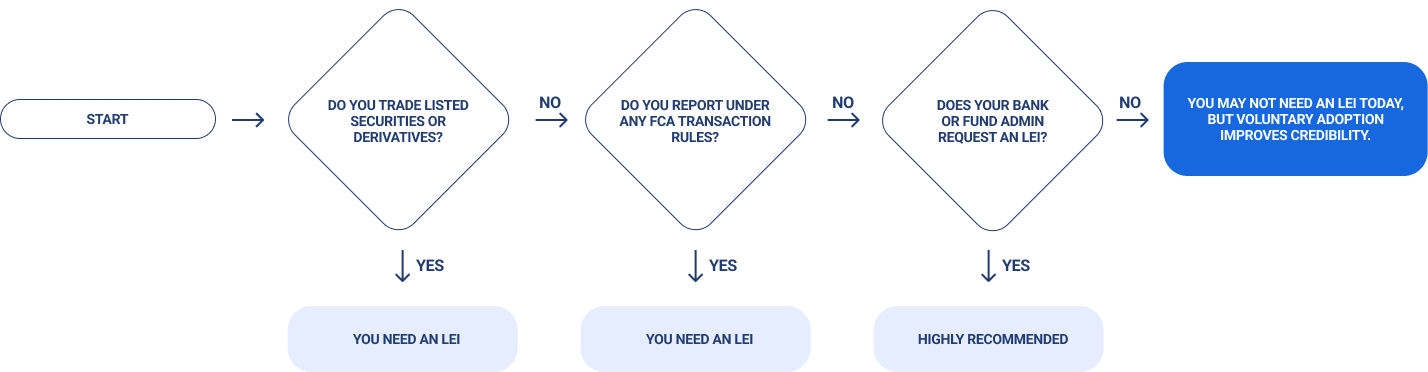
In many financial market contexts, a Legal Entity Identifier (LEI) is required for legal entities participating in regulated transactions or reporting. If your business trades shares, bonds, or derivatives, an LEI may be required depending on the transaction type, venue, and reporting regime involved.
Quick Decision: Do You Need an LEI?
Use this flowchart to determine whether your organization may require an LEI number.
You likely need an LEI if your UK legal entity:
Trades listed shares, bonds, ETFs, or derivatives
Uses a broker, bank, investment platform, or asset manager for reportable transactions
Takes part in repo, securities lending, or derivatives reporting
Opens or maintains a custody, clearing, or trading account where the bank requests an LEI
Operates as a fund, pension scheme, trust, charity, or company that holds financial instruments
You usually do not need an LEI if you are:
An individual trading in your own name
A sole trader without a separate legal entity
A business that does not trade financial instruments
A simple trust or informal organization with no reportable financial activity
When an LEI May Be Required for Trading
Under MiFID II and UK MiFIR regulations, financial institutions are legally prohibited from executing trades for clients who do not have an active LEI. In some contexts, this is informally described as a ‘No LEI, No Trade’ rule.
If an LEI is required for the transaction and the entity does not have one, a bank or broker may be unable to process the trade.
Organizations Required to Register for an LEI
Determining who needs an LEI number UK often depends on your specific entity type. Whether an entity needs an LEI depends on the type of transaction and the regulatory regime involved.
Limited Companies and PLCs
Any incorporated company in the UK that trades listed securities, bonds, or ETFs on a regulated venue must obtain an LEI. This includes small private limited companies (LTD) as well as larger public limited companies (PLC).
Investment Funds, Pension Schemes, and SSAS
Managed funds, including hedge funds, mutual funds, and Small Self-Administered Schemes (SSAS), require an LEI. While individual SIPPs (Self-Invested Personal Pensions) generally do not need their own LEI, the underlying scheme or provider usually does.
Charities, Trusts, and Foundations
LEI requirements can also apply to some non-profit organizations. If a charity or trust holds investments (such as a portfolio of stocks or bonds), they are classified as a legal entity and must register.
Financial Intermediaries
Banks, credit unions, brokers, and asset managers are mandated to have an LEI not only for their own trading but also to identify themselves in regulatory reports.
Financial Activities and LEI Applicability
Beyond who you are, LEI registration applicability is often triggered by what you do. The table below outlines the specific UK and international regulations that mandate the use of an LEI based on the instruments being traded.
Documents and Data You’ll Need
Regulation
Instruments covered
Entity types
Enforcement date
MiFID II Art 26
Shares, bonds, ETFs
Investment firms & clients
Jan 2018
EMIR & EMIR-REFIT
OTC & ETD derivatives
Financial & NFC entities
Jun 2014 / Jun 2020
SFTR (EU & UK)
Repos, securities lending
Borrower & lender
Jul 2020
CSDR
Settlement fails reporting
CSD participants
Feb 2022
Dodd-Frank (US)
Swaps
US counterparties
Apr 2013
Exemptions: When is an LEI Not Required?
While who needs an LEI number covers most business entities, there are specific exceptions:
Individuals: If you are a natural person trading for your own personal portfolio (and not on behalf of a business), you generally do not need an LEI.
Bare Trusts: In most cases, bare trusts that do not engage in complex financial reporting are exempt.
Non-Financial Operating Businesses: If your business is strictly operational (e.g., a local bakery or consultancy) and never trades shares or financial instruments, an LEI is not required.
Why Apply for an LEI Voluntarily?
Even if you aren’t legally mandated today, many businesses choose to obtain an LEI for registration applicability in the future.
Global Credibility: An LEI acts as a “digital business card,” proving your entity’s legitimacy on the global stage.
Onboarding Support: Having an LEI in place may help support KYC and onboarding processes when opening new bank accounts or trading lines.
Register, Renew, or Transfer Your LEI
Whether you need to register a new number, renew an expiring one, or transfer your management to LEI24, you can review our pricing and service options.
No. Companies only need an LEI if they trade financial instruments on regulated exchanges or if their financial institution requires one for mandatory transaction reporting and internal compliance procedures.
Yes, if trading as a legal entity. Under “No LEI, No Trade” rules, investment firms cannot facilitate transactions for entities without a valid LEI, ensuring transparency across UK financial markets.
Yes, if they are legal entities holding or trading financial instruments. Most UK investment platforms require an LEI from trusts to satisfy regulatory reporting obligations for all underlying transactions.
Yes. Banks and brokers often mandate an LEI as part of their KYC and internal compliance audits, even if a specific regulation doesn’t apply to the business’s everyday operations.
Without a valid LEI, companies are legally barred from trading listed securities or derivatives. Financial institutions may be unable to process relevant transactions where an LEI is required, which can lead to delays.