
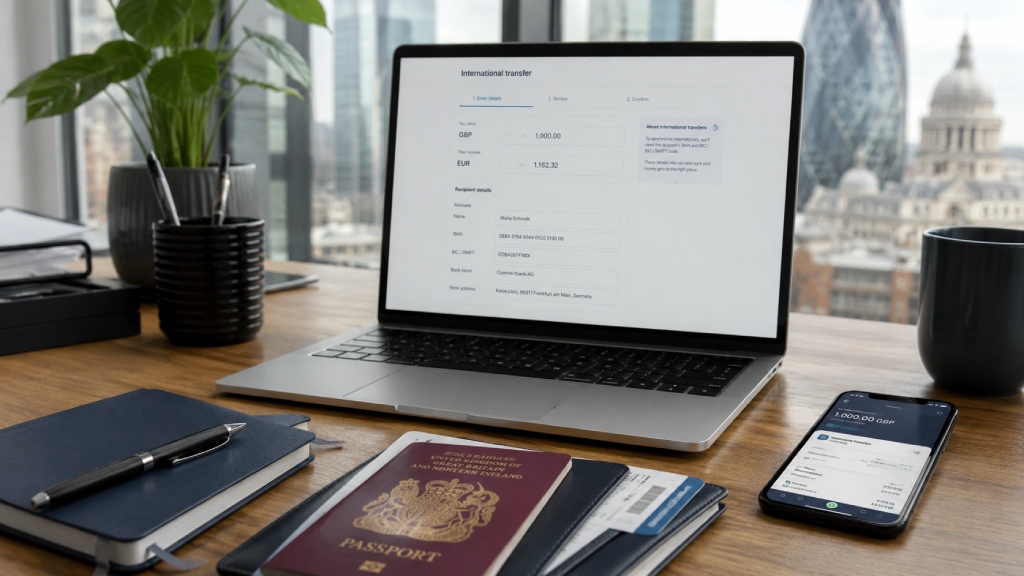
Anyone who has sent or received money internationally has been asked for a SWIFT code, a BIC, or an IBAN, usually at the worst possible moment with a payment waiting. The three sit at the heart of cross-border banking, they are easy to mix up, and getting one wrong is a common reason transfers bounce or land in the wrong place.
This guide explains what each one is, how they fit together, and where to find them. It is written from a UK perspective, where domestic payments run on a sort code and account number but international transfers pull in the SWIFT/BIC and, for European payments, the IBAN. It also covers the part most explainers leave out: these codes identify the bank and the account, while a separate code, the Legal Entity Identifier (LEI), identifies the business behind the payment.
What is a SWIFT code?
A SWIFT code is the standardised code that identifies a specific bank in an international transfer. SWIFT stands for the Society for Worldwide Interbank Financial Telecommunication, the secure messaging network that banks and financial institutions use to exchange payment instructions across borders. The network carries the message, and the SWIFT code tells it which institution the message is for.
That distinction is the whole of the SWIFT code meaning: it identifies the bank, not the account. When a transfer leaves the UK for an account abroad, the SWIFT code routes the instruction to the right institution, and a separate identifier (the account number or IBAN) tells that institution which account to credit. So when a form asks what a SWIFT code for a bank actually is, the honest answer is that it is the bank’s address within the global payment network, not a reference to any individual customer.
Every institution connected to SWIFT has at least one code. Larger banks have several: one for the head office and others for specific branches or business lines.
What is a BIC code?
BIC stands for Business Identifier Code, though it is still widely called a Bank Identifier Code, its older name. It is the formal, ISO-standardised name for the same string of characters most people call a SWIFT code. A BIC is eight or eleven characters long and identifies a financial institution in exactly the way described above.
The BIC code meaning trips people up only because two names exist for one thing. The standard behind it is ISO 9362, and SWIFT is the body appointed to assign and publish these codes, which is why the two terms ended up fused in everyday use.
Is a SWIFT code the same as a BIC?
Yes. A SWIFT code and a BIC are the same code. The terms are used interchangeably, and whether a payment form asks for a SWIFT code, a BIC, or a SWIFT/BIC, you are looking for the identical eight to eleven character string.
Two names survive for historical reasons. BIC is the official ISO term for the code itself, and SWIFT is the network that uses it and the organisation that issues it. People who ask whether the SWIFT code is the same as the BIC, or whether BIC and SWIFT are the same, are almost always staring at two boxes on a form and worrying they need two different numbers. They do not. One code covers both.
What does a SWIFT/BIC code look like?
A SWIFT/BIC code is built from up to four parts, read left to right:
| Segment | Length | What it identifies |
| Institution code | 4 letters | The bank or financial institution |
| Country code | 2 letters | The country, using the ISO country code (GB for the United Kingdom) |
| Location code | 2 characters | The city or head office location |
| Branch code | 3 characters (optional) | A specific branch, if included |
An eight-character code points to a bank’s primary office. An eleven-character code adds the branch segment to point at a specific branch. Where no branch is specified, the code is sometimes written with XXX in the final three positions.
Take Barclays in the UK as an example: BUKBGB22. BUKB is the institution, GB is the country, and 22 is the location. Add a branch and it becomes an eleven-character code. A UK SWIFT code always carries GB in the fifth and sixth positions, which is the quickest way to confirm at a glance what a SWIFT code looks like for a UK bank.
What is an IBAN number?
An IBAN, or International Bank Account Number, identifies a specific bank account rather than the institution that holds it. Where a SWIFT/BIC says which bank, the IBAN says which account at that bank, which is why international transfers into Europe usually require both.
An IBAN can run up to 34 alphanumeric characters and follows the ISO 13616 standard. It begins with a two-letter country code and two check digits, which let a bank validate the number before any money moves, followed by the domestic account details. A UK IBAN is 22 characters and looks like this: GB29 NWBK 6016 1331 9268 19, where the country code, check digits, bank code, sort code and account number are all packed into a single string.
One UK-specific point clears up a lot of confusion. British banks issue IBANs, but the UK does not use them for domestic payments, which run on the sort code and account number through Faster Payments, Bacs and CHAPS. The IBAN matters mainly when money crosses into or out of the Single Euro Payments Area.
SWIFT/BIC vs IBAN: what’s the difference?

The simplest way to hold the difference in your head: the SWIFT/BIC is the address of the building, and the IBAN is the door number of the flat inside it. One gets the payment to the right bank, the other gets it to the right account.
| SWIFT / BIC | IBAN | |
| Identifies | The bank or institution | The specific account |
| Length | 8 or 11 characters | Up to 34 characters |
| Format | Letters and digits | Country code, check digits, then account details |
| Used | Worldwide | Mainly Europe, the Middle East and parts of Africa |
| UK domestic use | Not used domestically | Not used domestically |
Which one you need depends on where the money is going. A euro transfer into the SEPA area typically needs the recipient’s IBAN and BIC. A US payment usually needs a routing number and account number instead. A domestic UK payment needs neither, just the sort code and account number.
What neither code does is identify the company behind the account. A SWIFT/BIC names the bank and an IBAN names the account, but a payment can pass through both without anyone confirming which legal entity actually owns the money. That gap is filled by a 20-character code that identifies the legal entity itself, which is where the LEI comes in later in this guide.
Where to find your SWIFT/BIC code and IBAN
Both are easier to find than most people expect:
- Online or mobile banking: usually listed under account details or international payment details.
- Bank statements: the SWIFT/BIC and IBAN are often printed near the account number.
- The bank’s website: most publish their SWIFT/BIC, since it is the same for every customer at that institution.
The SWIFT/BIC is shared and public, identical for everyone banking with that institution. The IBAN is unique to your account, so treat it like your account number: fine to give to someone who needs to pay you, worth keeping off public view otherwise.
SWIFT, BIC, IBAN and the LEI: identifying the business behind a payment

For an individual sending money to family abroad, the SWIFT/BIC and IBAN are enough. For a business, there is a third identifier in the picture, and it answers a question the payment codes cannot: who is the legal entity behind this transaction?
A wrong or outdated code is one of the most common causes of failed cross-border payments, and for a company a bounced payment is not just an inconvenience. It carries cost, delay and reconciliation work. Accurate identifiers also sit at the centre of compliance, because banks have to know exactly who they are paying and who is paying them.
The LEI, or Legal Entity Identifier, is a 20-character code built on the ISO 17442 standard that uniquely identifies a legal entity in financial transactions anywhere in the world. It is governed by the Global Legal Entity Identifier Foundation (GLEIF) and overseen by the LEI Regulatory Oversight Committee under the Financial Stability Board. Each code can be looked up in a public, searchable register, so any counterparty can confirm who they are dealing with.
The connection to SWIFT and the BIC is not theoretical. The BIC sits on the same ISO foundations as the LEI (the BIC is ISO 9362, the LEI is ISO 17442), and SWIFT, as the body that assigns BICs, has worked with GLEIF since 2018 to publish a free, open-source file that maps a bank’s BIC to its LEI. The two identifier systems are being stitched together on purpose.
The reason is transparency. A BIC reliably identifies an institution on the network, but it does not always pin down the precise legal entity, because BICs are also assigned to branches, desks and departments. Under ISO 20022, the new global standard for payment messaging, regulators and GLEIF are pushing for the LEI to travel alongside the BIC in cross-border payment messages, so that every payment carries a clean answer to who is who. The same logic already runs through transaction reporting regimes, where the LEI is mandatory for identifying the parties to a trade.
The practical takeaway for businesses is simple. If your company trades regulated instruments, reports derivatives, opens corporate accounts or issues securities, it is one of the entities that needs an LEI, often because a bank or broker will not complete onboarding without one.
If your business needs one, you can register or renew an LEI with LEI24 in minutes, with issuance handled through an accredited issuer.
Frequently asked questions
Do I need both a SWIFT code and an IBAN?
For most transfers into Europe, yes. The SWIFT/BIC routes the payment to the right bank and the IBAN directs it to the right account. For a domestic UK payment you need neither, just the sort code and account number, and for a US payment you typically use a routing number and account number instead.
Does the UK use IBANs?
UK banks issue IBANs, and you will need yours to receive payments from abroad, particularly from the Single Euro Payments Area. Within the UK, though, domestic transfers run on the sort code and account number, not the IBAN.
Is a SWIFT/BIC code the same as a UK sort code?
No. A sort code is a six-digit number that identifies a UK bank and branch for domestic payments. A SWIFT/BIC does a similar job at international level, identifying the institution across the global network. They are not interchangeable, and an international transfer needs the SWIFT/BIC, not the sort code.
How many characters is a SWIFT/BIC code?
Eight or eleven. An eight-character code identifies a bank’s primary office, and an eleven-character code adds a three-character branch segment to point at a specific branch.
Is it safe to share your SWIFT/BIC code?
Yes. A SWIFT/BIC is public information, the same for every customer of that bank, and it is needed for anyone to send you an international payment. Your IBAN is account-specific, so share it only with people who need to pay you, the same way you would treat your account number.
What is the difference between a SWIFT code and an LEI?
A SWIFT/BIC identifies the bank in a transaction. An LEI identifies the legal entity, the actual company, on either side of it. The two answer different questions: which institution is handling the money, versus which business owns it. Companies active in regulated markets increasingly need both, and the LEI is now a fixture of regulatory reporting and cross-border payment transparency.